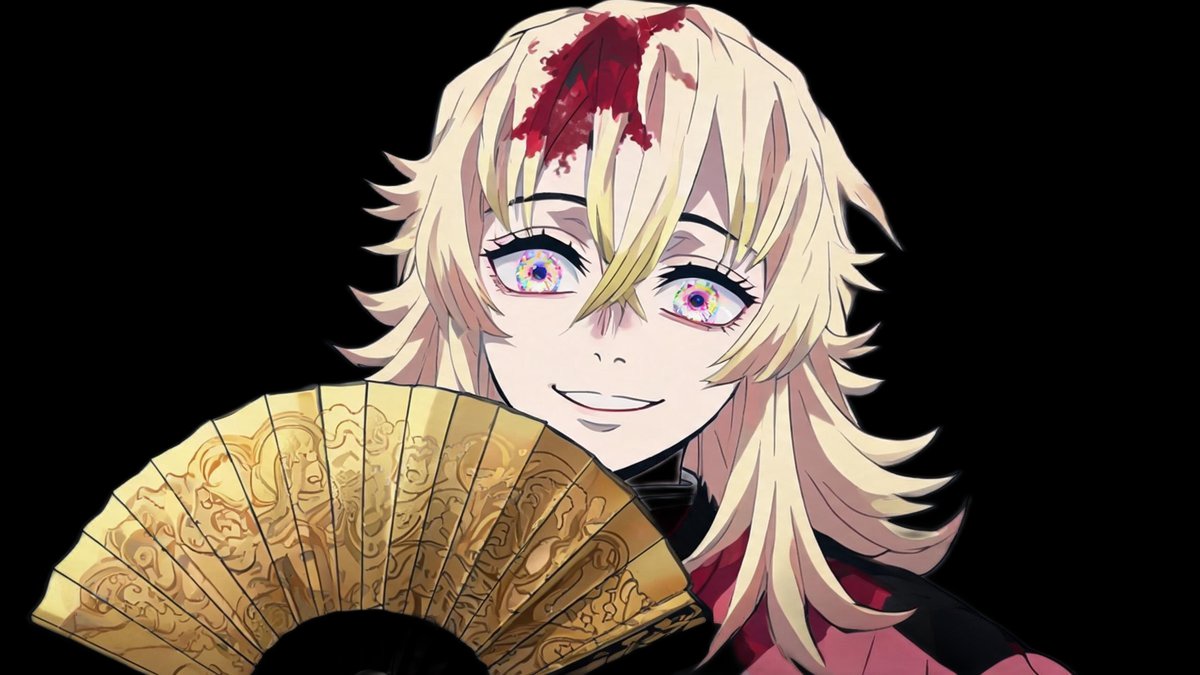
Iconic Quote
“I feel nothing at all. Human emotions are such a troublesome thing.”
Overview
Doma is Upper Moon 2, the second most powerful demon serving Muzan, and the leader of a cult called the Eternal Paradise Faith. He was born without the capacity for human emotions, viewing people as nothing more than food, yet he cultivated a massive following as a charismatic religious leader. He is responsible for killing Shinobu's older sister Kanae Kocho years before the main story, and later faces Shinobu herself in the Infinity Castle, a confrontation that would lead to one of the most unique defeats inflicted on an Upper Moon.
What makes Doma particularly terrifying among the Upper Moons is his complete lack of emotional connection to his actions. Unlike Akaza who feels the thrill of combat or Kokushibo who harbors deep jealousy, Doma feels nothing at all. He kills, eats humans, and destroys lives with the same emotional detachment that a person might feel while eating a meal, making him incapable of empathy or remorse. This emotional void makes him uniquely dangerous because he cannot be reasoned with, intimidated, or manipulated through emotional appeals.
Despite his rank, Doma may be the most powerful Upper Moon after Kokushibo, as his ice-based abilities counter almost every other Blood Demon Art. Even Muzan seems to regard Doma with a mixture of appreciation for his power and unease at his unreadable nature. Doma's cult following during his human years gave him extensive experience in manipulating people, skills he continues to use as a demon to lure victims and maintain his position in the demon hierarchy.
Appearance
Doma has pale skin, rainbow-colored eyes with a distinctive ring pattern, and chin-length platinum blond hair with red undertones that he styles neatly parted. He wears a white cult leader's robe over a light purple kimono with floral patterns, and he always maintains a serene smile. His blood-red spot on his forehead resembles a Buddhist bindhi but marks him as a demon.
The deliberate beauty of Doma's appearance is essential to his hunting strategy. His gentle smile, kind eyes, and elegant robes make him appear trustworthy and compassionate, allowing him to attract followers who would never suspect his demonic nature. In combat, his appearance barely changes, as he maintains his serene expression even while killing, making his violence all the more disturbing. This contrast between his angelic appearance and his complete emotional emptiness is what makes Doma one of the most unsettling characters in Demon Slayer.
When Doma uses his ice-based Blood Demon Art, crystalline frost forms around him, creating an icy halo that enhances his religious leader aesthetic while simultaneously freezing his opponents. His rainbow-colored eyes, which shift between different colors depending on the lighting, become more intense and hypnotic during battle, making it difficult for opponents to look away. Even in death, Doma maintained his serene smile, dissolving into ice crystals rather than the standard ash of other demons, a fitting end for a being whose emotional coldness defined his entire existence.
Personality
Doma is incapable of feeling genuine emotions, including happiness, sadness, anger, or love, and views humans as mere food despite his gentle and caring outward demeanor. He presents himself as a serene, kindly religious leader, but this is a perfect imitation of emotions he has never actually experienced. He is fascinated by those who feel deeply, like Shinobu and Akaza, because he cannot understand genuine emotion himself and studies them with detached curiosity.
His emotional void makes him unpredictable in combat, as he does not experience fear, anger, or hesitation that would normally affect a demon's fighting ability. He analyzes battles with cold rationality, never losing his composure even when facing death. This detachment allowed him to recognize Shinobu's poison strategy even as he was being defeated, appreciating her cleverness with genuine admiration he could intellectually understand even if he could not feel it emotionally.
Doma's fascination with emotions extends to his relationships with other Upper Moons. He finds Akaza's hatred amusing, Kokushibo's melancholy intriguing, and Muzan's paranoia entertaining. He treats his interactions with other demons as a form of research, constantly observing and cataloging emotional responses he cannot experience himself. This makes him a poor ally but an effective operator within the demon hierarchy, as his lack of personal ambition or emotional attachments means he never acts against Muzan's interests.
Abilities
Doma's Blood Demon Art is ice-based, allowing him to create freezing mist, ice sculptures, and crystalline structures that can shatter opponents. He can manifest ice-based Buddhist statues to attack and create freezing winds that can lower his opponent's body temperature fatally. His ice techniques are so powerful that he can freeze demons and destroy their cells entirely, preventing regeneration, making him uniquely dangerous even among the Upper Moons.
His cryokinesis has multiple combat applications that make him effective against both single targets and groups. He can create freezing mist that obscures vision while lowering body temperature, crystalline walls for defense, ice projectiles for ranged attacks, and massive ice sculptures that fight autonomously. His most devastating technique creates an ice Buddha that releases freezing shockwaves capable of freezing entire battlefields in moments.
Beyond his Blood Demon Art, Doma possesses the physical abilities expected of Upper Moon Two, including superhuman speed, strength, and regeneration. However, his true combat advantage lies in his analytical mind and emotional detachment. He never panics, never hesitates, and never becomes overconfident, allowing him to fight at peak efficiency at all times. His only weakness is his curiosity about emotions, which can cause him to prolong battles to observe his opponents' feelings, a trait that ultimately contributed to his downfall against Shinobu's meticulous poison plan.
Trivia
Doma was born without emotions and faked his entire personality so convincingly that his own followers never suspected he was a demon. He killed his own parents after they discovered his true nature and made it look like an accident. He absorbed Shinobu after defeating her but was ultimately killed by the massive dose of wisteria poison she had concentrated in her body over years as part of a meticulous revenge plan.
His cult, the Eternal Paradise Faith, was founded during his human life and continued to operate even after he became a demon, providing him with a constant supply of victims who willingly followed him. The cult's teachings promised salvation and eternal happiness, an ironic theme given Doma's own inability to experience happiness. His followers were so devoted that even after his death, many refused to believe he was a demon, illustrating the power of charismatic leadership and the danger of blind faith.
Doma's relationship with Akaza is one of the most interesting dynamics among the Upper Moons. While Akaza openly despised Doma for his mocking attitude toward genuine emotion, Doma found Akaza's hatred genuinely fascinating, as it represented a depth of feeling he could never experience. This mutual animosity was purely one-sided in terms of genuine emotion, as Doma was simply a curious observer while Akaza's hatred was real and deeply felt, creating an asymmetric relationship that persisted until both their deaths.
Doma's ice-based Blood Demon Art manifests through crystalline structures that grow increasingly elaborate as he unleashes more power, from simple ice projectiles to massive Buddhist statue constructs that fight autonomously. The Buddhist imagery in his techniques is deeply ironic given his role as a cult leader who preached salvation while consuming his followers, corrupting religious iconography for predatory purposes. His folding fan, a seemingly harmless accessory, serves as a conduit for his ice techniques, allowing him to spread freezing mist across wide areas with a casual gesture. The aesthetic beauty of his ice attacks, described by characters as almost artistic in their crystalline perfection, contrasts sharply with the horror of his true nature, making him one of the most visually striking demons in the series. His ability to freeze demon cells permanently, preventing regeneration entirely, makes him uniquely dangerous even among the Upper Moons, as he can kill demons who would otherwise survive decapitation.
Key Battles
Doma's most significant battle was against Shinobu Kocho, the Insect Hashira, in the Infinity Castle. Shinobu had prepared for this confrontation for years, knowing that her smaller stature and lighter strikes would never be enough to decapitate Doma through conventional means. Instead, she developed a unique fighting style centered around delivering massive doses of wisteria poison through repeated stab wounds, trusting that her body would absorb enough poison even as Doma consumed her. Her plan succeeded beyond its tragic cost, as Doma absorbed her into his body and received a lethal concentration of poison that slowly destroyed him from within.
Following Shinobu's sacrifice, Kanao Tsuyuri and Inosuke Hashibira continued the battle against a rapidly weakening Doma. Kanao, Shinobu's adopted sister, used her Flower Breathing techniques with devastating precision, targeting the accumulated poison within Doma's body to accelerate its effects. Inosuke, despite his reckless nature, proved instrumental by using his tactile sense to detect Doma's attacks through the freezing mist and coordinating with Kanao for a final joint assault that decapitated Upper Moon Two.
Before the Infinity Castle, Doma had also defeated Kanae Kocho, Shinobu's older sister, years earlier in a prior encounter. This earlier victory set the stage for Shinobu's lifelong vendetta and her methodical preparation for the rematch. Doma's ice Blood Demon Art proved particularly effective against Insect and Flower Breathing users, whose precision-based techniques were hampered by the freezing temperatures and reduced visibility in his ice mist.
Relationships and Influence
Doma's relationship with Shinobu Kocho was defined by a tragic irony she never lived to appreciate. He was genuinely fascinated by her intense hatred and desire for revenge, emotions he could observe but never truly experience himself. He complimented her skills sincerely during their fight, and his lack of malice made her vengeance somehow less satisfying, as he accepted his death not with fear or regret but with a detached curiosity about what it felt like to die. This emotional void at his core made him one of the most unsettling characters in the series, as his pleasant demeanor masked a complete absence of human connection.
His relationship with Akaza was uniquely hostile among the Upper Moons. Akaza openly despised Doma for his mocking attitude toward emotions and his tendency to philosophize about feelings he could not actually experience. The animosity was so intense that Akaza refused to speak to Doma unless necessary, and their mutual dislike was well known among the Upper Moon ranks. This enmity was purely one-sided in terms of genuine feeling, as Doma found Akaza's hatred amusing rather than threatening, viewing it as another interesting phenomenon to observe without truly understanding.
As the founder of a religious cult during his human life, Doma exerted enormous influence over his followers, who genuinely believed in his teachings of salvation and compassion. He used this religious authority to select and consume his victims without suspicion, building a vast network of believers who protected him unwittingly. His cult's influence extended beyond his lifetime, as his teachings continued to circulate among survivors who refused to believe their beloved leader was a demon, providing a chilling commentary on the power of charismatic leadership over truth.