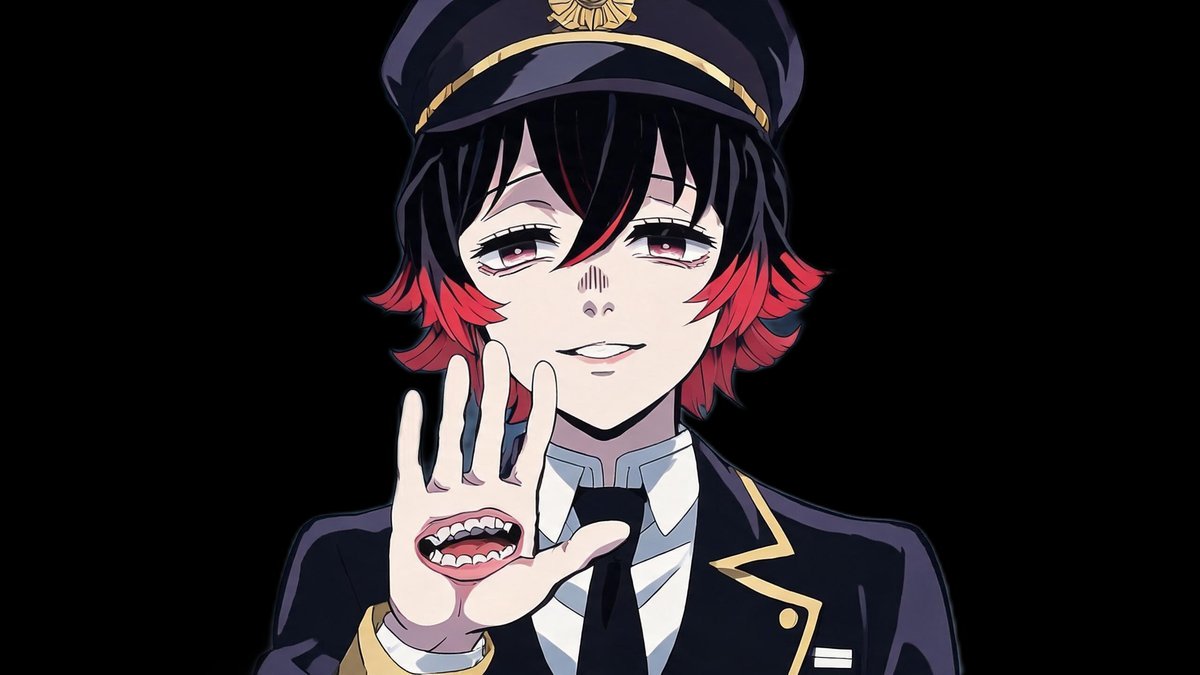
Iconic Quote
“Sleep is the cousin of death. And I am the guide between them.”
Overview
Enmu is Lower Moon 1, the highest-ranked Lower Moon under Muzan Kibutsuji, and the primary antagonist of the Mugen Train arc. He possesses a unique and disturbing Blood Demon Art that allows him to manipulate the dreams of sleeping humans, trapping them in blissful dreams while his demonic servants destroy their souls. He fused his body with the Mugen Train itself in his final desperate battle against the Demon Slayers, a strategy that reflected his theatrical and obsessive nature.
As the sole surviving Lower Moon after Muzan dissolved the Lower Moon ranks, Enmu was given a special infusion of Muzan's blood that dramatically increased his power and made him a credible threat even to Hashira. This favor from Muzan filled Enmu with desperate loyalty, driving him to prove his worth through the Mugen Train mission. His fanatical devotion to Muzan contrasts with the more pragmatic attitudes of the Upper Moons, highlighting his lower status and his need to compensate through excessive zeal.
Enmu's dream-based abilities make him one of the most psychologically disturbing demons in the series, as he attacks his victims at their most vulnerable: their hopes, desires, and memories. Unlike demons who kill through physical violence, Enmu breaks his victims by corrupting their fondest dreams, making them complicit in their own destruction. This psychological approach to killing reflects his twisted worldview that the most beautiful deaths are those where the victim dies happy, unaware that their joy is an illusion masking their annihilation.
Appearance
Enmu has an androgynous appearance with pale skin, wide unsettling eyes with no visible pupils, and straggly black hair. He wears a white kimono that gives him a ghostly, hospital-gown-like appearance, and his limbs appear unnaturally long and thin. After fusing with the Mugen Train, he manifests enormous demonic eyes and mouths across the train's surface, making the entire vehicle a part of his demon body.
His visual design emphasizes his otherworldly and unnatural nature, with features that are almost human but not quite right. The absence of pupils in his eyes makes it impossible to tell where he is looking, creating an unnerving effect that unsettles both characters in the story and viewers alike. His thin, elongated limbs suggest a fragility that is deceptive, as he possesses the strength and speed expected of a Lower Moon enhanced by Muzan's blood.
The transformation of the Mugen Train into Enmu's demonic form is visually spectacular, as eyes, mouths, and flesh-colored tendrils spread across the train's surface, turning a mundane vehicle into a living nightmare. This fusion represents the ultimate expression of Enmu's desire to trap his victims in his dream world, as the train itself becomes a physical extension of his dream manipulation, carrying his victims toward their doom while they sleep unaware.
Personality
Enmu is sadistic, theatrical, and takes genuine pleasure in the suffering of his victims, particularly enjoying the psychological torment of trapping people in happy dreams before destroying their souls. He is devoted to Muzan and desperately seeks his approval, viewing the destruction of the Demon Slayers as the path to earning his master's favor. He has a twisted sense of artistry, viewing his dream manipulation as a form of creative expression.
His theatrical nature extends to how he treats his victims, as he sees their dreams as canvases for his dark art, crafting elaborate illusions tailored to each person's deepest desires and fondest memories. He takes particular pleasure in observing the moment of realization when victims discover their happiness is an illusion, a cruelty that sets him apart from more straightforward demons who kill through brute force. This psychological approach to combat reflects his belief that the most devastating wounds are not physical but emotional, and that destroying a person's hope is far more satisfying than simply ending their life.
Enmu's desperation for Muzan's approval leads him to take unnecessary risks and pursue elaborate strategies that prioritize spectacle over efficiency. Unlike the calculated Upper Moons who value direct results, Enmu approaches his missions with artistic flair, designing intricate dream scenarios rather than opting for straightforward kills. This need for recognition stems from his position as the only Lower Moon spared during Muzan's dissolution of the ranks, creating a psychological burden that drives him to constantly prove his worth through increasingly elaborate schemes. His fusion with the Mugen Train was the ultimate expression of this need, a grand theatrical gesture that ultimately cost him his life.
Abilities
Enmu's Blood Demon Art allows him to enter and manipulate the dreams of sleeping humans, typically trapping them in a dream of their heart's desire while a demon servant attacks their spiritual core. He can also force people into nightmares and manipulate their sleepwalking bodies to attack each other. After merging with the Mugen Train, he gains control over the entire vehicle, extending his flesh throughout the train's structure to create tentacles and repair damage.
Beyond basic dream manipulation, Enmu can bind sleeping victims to a specific dream scenario of his choosing, making them relive their happiest memories while his demon servants, the Dream Demons, infiltrate their subconscious to destroy their spiritual cores from within. These Dream Demons can take the form of people the victim trusts, making the psychological attack even more devastating as victims must fight loved ones or mentors within their own minds. This multi-layered assault makes Enmu particularly dangerous, as his victims must simultaneously fight external demon servants while maintaining awareness that their dream world is an illusion, a task that proves nearly impossible for even trained Demon Slayers.
After fusing his body with the Mugen Train, Enmu gained comprehensive control over the entire vehicle, manifesting demonic eyes, mouths, and flesh tentacles across its surface. He could repair structural damage to the train instantly, create flesh barriers to trap passengers in their compartments, and extend his neck from any part of the train's body to attack from unexpected angles. The fusion also allowed him to control the train's movements independently of its tracks, creating a mobile battlefield that constantly shifted. This fusion represented the ultimate expression of Enmu's dream manipulation philosophy, turning a mundane machine into a living nightmare that literally carried its victims to their doom.
Trivia
Enmu was originally a sickly child with a fascination with death and drawn to images of corpses, which led to his transformation into a demon. He was the only Lower Moon not killed by Muzan when he dissolved the Lower Moon ranks after Rui's defeat. He received a special infusion of Muzan's blood to strengthen him before the Mugen Train mission. His name means 'distant dream' in Japanese, reflecting his dream-themed abilities.
Despite his high rank as Lower Moon One, Enmu was ultimately expendable in Muzan's eyes, serving primarily as a test for the Demon Slayer Corps after the Upper Moons retreated to the Infinity Castle. His defeat foreshadowed the far greater threat that Akaza posed immediately after, as the Upper Moon's arrival on the Mugen Train moments after Enmu's death demonstrated the vast power gap between Lower and Upper Moons. The Mugen Train arc is unique in the series for having a Lower Moon as its primary antagonist, making Enmu one of the few non-Upper Moon main villains.
Enmu's visual design draws heavily from Japanese yokai folklore involving dream-eating creatures like the Baku, a mythical being that devours nightmares. His androgynous appearance and unsettling features were inspired by traditional Japanese Noh theater masks, which use neutral expressions that can be interpreted as any emotion depending on context. The visual motif of eyes appearing across his body and the train reflects the theme of being watched, a psychological horror element that reinforces his dream manipulation abilities. His transformation sequence during the Mugen Train battle is visually striking, as his body grotesquely merges with the mechanical structure of the train, creating one of the most memorable visual moments in the series.
Enmu's position as Lower Moon One places him uniquely within the demon hierarchy, as he was the only Lower Moon spared during Muzan's purge and personally strengthened for a critical mission against the Demon Slayer Corps. His dream manipulation abilities made him a particularly insidious threat, preying on the deepest desires of his victims rather than confronting them directly in combat. The irony of Enmu's demise is that his own obsession with dreams and sleep became his undoing, as the Demon Slayers he underestimated proved capable of awakening from his illusions through sheer willpower and the bonds they shared with one another, a power Enmu could never understand.
Key Battles
Enmu's climactic battle on the Mugen Train was one of the most unique confrontations in Demon Slayer, as it played out across two simultaneous fronts: the physical world and the dream world. While Tanjiro, Zenitsu, Inosuke, and Rengoku were trapped in their dreams, Enmu's demon servants infiltrated each dream to attack the sleeping Demon Slayers' spiritual cores. This dual-layer battle required the protagonists to not only fight Enmu's physical form but also recognize they were dreaming and wake themselves up through their own willpower.
Tanjiro's battle against Enmu's dream manipulation was particularly harrowing, as his dream showed him his family alive and well, a temptation that nearly cost him his life. The moment Tanjiro realized he was dreaming by noticing inconsistencies in his dream environment demonstrated the series' theme that clinging to the past prevents growth. Once awake, Tanjiro chased Enmu across the roof of the speeding train, engaging in a desperate duel while the train hurtled through the night.
The final phase of the battle occurred after Enmu fused his body with the Mugen Train, transforming the entire vehicle into his demon form. Tanjiro was forced to use his Sun Breathing techniques to sever Enmu's neck while simultaneously saving the passengers, all while Inosuke protected Tanjiro's physical body from the train's demonic flesh. The victory came at a terrible cost, as the battle weakened Rengoku sufficiently that he was vulnerable to Akaza's attack moments later, making Enmu's defeat bittersweet.
Relationships and Influence
Enmu's relationship with Muzan Kibutsuji was defined by his desperate desire for approval and recognition. After Muzan dissolved the Lower Moon ranks, Enmu was the only Lower Moon spared, receiving a special infusion of Muzan's blood that significantly increased his power. This favor made Enmu fanatically loyal, viewing the Mugen Train mission as his opportunity to prove his worth and potentially be elevated to an Upper Moon position. His desperate need for validation from Muzan drove him to take increasingly reckless risks in his battle strategy.
The Mugen Train incident had a profound influence on the Demon Slayer Corps, both as a victory and a tragedy. The successful elimination of Lower Moon One proved that the Corps could defeat even enhanced Lower Moons, boosting morale among the rank-and-file Demon Slayers. However, the permanent loss of Kyojuro Rengoku, the Flame Hashira, in the immediate aftermath represented a devastating blow that weakened the Corps' fighting strength and left a leadership vacuum that would take time to fill.
Enmu's dream manipulation ability also had significant thematic importance, as it forced the main characters to confront their deepest desires and traumas. Tanjiro had to let go of his fantasy of his family surviving, Zenitsu had to overcome his self-doubt, and Inosuke had to accept that strength alone was not enough. This psychological battle served as a growth catalyst for the trio, preparing them for the even greater challenges that lay ahead in the Swordsmith Village and Infinity Castle arcs.