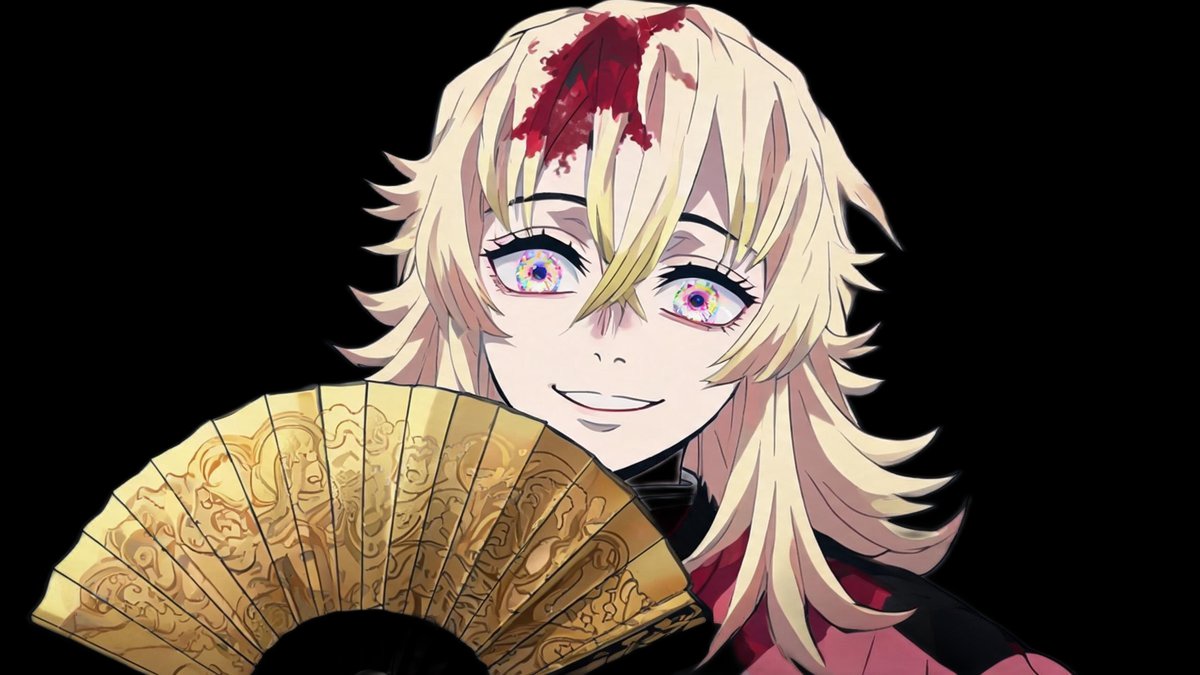
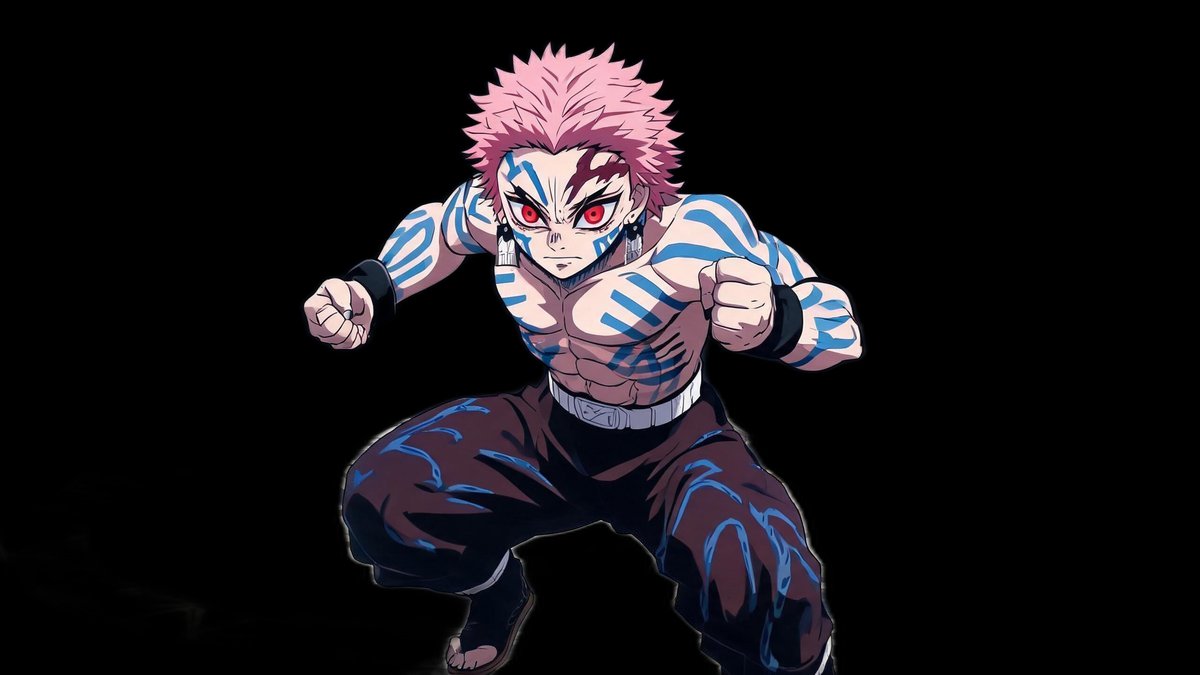
Gyutaro and Daki were born into extreme poverty in the Entertainment District's slums. Gyutaro, the older brother, was born with a sickly appearance and grotesque features, shunned by everyone except his younger sister Ume (later Daki). Ume was beautiful and became a popular oiran apprentice, but after stabbing a samurai who insulted her, she was burned alive. Gyutaro, devastated, tried to save her but was beaten within an inch of his life. As they lay dying, Doma discovered them and offered them Muzan's blood. Gyutaro accepted without hesitation, becoming a demon to protect his sister forever. They merged into a single demon sharing the Upper Moon 6 rank, with Daki serving as the public face and Gyutaro as the hidden true power.
The siblings' transformation into demons was a complete redefinition of their existence. As humans, they had been powerless victims of a society that valued beauty and wealth above all else, leaving them with nothing but each other. As demons, they became the predators rather than the prey, turning the Entertainment District into their personal hunting ground for over a century. Gyutaro embraced his monstrous appearance as a source of power rather than shame, while Daki wielded her beauty as a weapon rather than a vulnerability. Their symbiotic relationship, born from shared trauma and mutual protection, became the foundation of their strength as Upper Moon Six, a rank they held for over a hundred years before the events of the main series.
Shared Body Mechanic
Gyutaro and Daki share a unique biological connection as Upper Moon 6. Daki acts as the outer shell, a beautiful courtesan who roams the Entertainment District luring victims. Gyutaro hides within Daki's body, emerging from her back to fight. To kill them, both heads must be decapitated simultaneously. If only one is beheaded, the surviving sibling can regenerate the other, making them exceptionally difficult to defeat. Daki controls sashes made of her own flesh that can strangle, constrict, and cut opponents. Gyutaro wields two kama (sickles) that can slice through almost anything and unleashes slashing waves of blood, his Blood Demon Art. The sibling pair covers each other's weaknesses perfectly: Daki excels at crowd control while Gyutaro delivers lethal finishing blows.
The biological mechanics of their shared existence are unique among the Twelve Kizuki. Daki's body serves as the primary vessel, with Gyutaro residing within a hidden flesh pocket connected to her internal organs. This connection allows Gyutaro to supply Daki with enhanced regeneration and demonic energy, making her significantly more durable than a demon of her actual rank would be. Conversely, Daki's decapitation drains Gyutaro's energy reserves, creating a vulnerability that skilled opponents can exploit over the course of a prolonged battle. The shared body also means that injuries sustained by one sibling are partially transferred to the other, a double-edged sword that both protects them and makes them jointly vulnerable to sustained assault from multiple attackers.
Blood Demon Arts and Combat Style
Gyutaro's Blood Demon Art revolves around his twin kama sickles, which he wields with devastating speed and precision. He can create slashing waves of blood that extend the reach of his weapons, allowing him to attack from a distance while remaining in close combat range. His fighting style is aggressive and relentless, overwhelming opponents with rapid successive strikes that leave little room for counterattacks. Gyutaro's physical strength is disproportionate to his lean frame, allowing him to overpower even a Hashira in direct physical confrontation.
Daki's combat abilities center around her obi sashes, which she can control telekinetically to attack multiple opponents simultaneously from any direction. These sashes are made from her own flesh and can vary in texture from soft fabric that constricts victims to blade-sharp edges that can slice through flesh and bone. Her Blood Demon Art excels at area control and crowd suppression, forcing opponents to divide their attention between avoiding her sashes and closing the distance to engage her directly. Against non-Hashira Demon Slayers, Daki's sashes are nearly insurmountable, as demonstrated by her effortless defeat of numerous lower-ranked Corps members.
The combination of Gyutaro's close-range lethality and Daki's mid-range area control makes Upper Moon 6 exceptionally dangerous as a team. While an opponent is occupied deflecting Daki's sashes, Gyutaro can emerge from hiding to deliver a killing blow. This symbiotic fighting style is the foundation of their Upper Moon ranking, as neither sibling would qualify for the position alone. Daki's abilities alone would place her at Lower Moon class at best, while Gyutaro's raw power would rank him among the lower Upper Moons but not as high as their combined strength allows.
The Entertainment District Battle
The Entertainment District arc features the Sound Hashira Tengen Uzui, Tanjiro, Zenitsu, and Inosuke on a mission to uncover the demon plaguing the district. After Daki captures Tengen's wives, the demon slayers infiltrate the district in disguise. The battle escalates dramatically when Tanjiro discovers Gyutaro hiding inside Daki, forcing the slayers to fight both siblings simultaneously. Zenitsu decapitates Daki while Inosuke and Tanjiro struggle against Gyutaro's ferocious attacks. Tengen, despite losing an arm and an eye, pushes Gyutaro to his limits. Tanjiro awakens the Dance of the Fire God and uses the key technique, Hinokami Kagura: Sunflower Thrust, to create the opening Tengen needs to behead Gyutaro.
Zenitsu's role in the battle was particularly crucial, as his decapitation of Daki using Thunder Breathing forced Gyutaro to emerge from hiding and reveal their symbiotic relationship to the Demon Slayers. Inosuke's wild combat style and enhanced tactile senses allowed him to track Gyutaro's movements even when the demon attempted to use Daki's body as a decoy, providing critical intelligence to his fellow slayers. The battle reached its climax when Tanjiro, guided by Nezuko's selectively burning flames that targeted Muzan's cells, executed the Hinokami Kagura: Sunflower Thrust with such precision that it created the split-second opening Tengen needed to sever Gyutaro's head. The simultaneous decapitation of both siblings required perfect timing and coordination, a feat that demonstrated how far the Demon Slayers had grown as a team since their earlier battles.
Death and Redemption
When both siblings are decapitated, their shared existence causes them to dissipate together. In their final moments, Gyutaro and Daki remember their tragic human lives. Gyutaro bitterly laments how he was hated for his appearance and wishes he could have been born as his beautiful sister instead. Daki admits she always loved and relied on her brother despite her vanity. They express hope that in their next life, they will be reborn under better circumstances, perhaps as a child who is loved rather than hated. Their death scene is one of the most poignant in Demon Slayer, showing that even the most monstrous demons were once humans shaped by suffering and cruelty.
The spiritual impact of Gyutaro and Daki's death extends beyond their personal tragedy to serve as a powerful commentary on the cycle of poverty and violence in feudal Japan. Born into the lowest social stratum, they were denied the opportunities, education, and compassion that might have led them to different paths. Their story challenges the simplistic binary of good and evil, presenting demons not as inherently evil beings but as products of a society that failed them at every level. The series' decision to show their final moments as a shared acceptance of death rather than a desperate struggle for survival elevates their narrative from simple revenge fantasy to genuine tragedy, reinforcing the message that every demon was once a human whose suffering led them down a dark path from which they could not return.
Pro Tip: To decapitate Gyutaro and Daki simultaneously, both heads must be cut off at nearly the same moment. If even a second passes between decapitations, the surviving sibling regenerates the other. This unique shared immortality is exclusive to them among the Upper Moons and made them arguably the most difficult Upper Moon to kill relative to their rank.
Personality and Motivation
Gyutaro's personality was forged by a lifetime of rejection and abuse. Born with a grotesque appearance that repulsed everyone around him, he developed a deep-seated resentment toward society and a fierce, protective love for the only person who ever showed him kindness: his sister Daki. He viewed himself as a monster long before becoming a demon, internalizing the cruelty of others until it became the core of his identity. As a demon, he embraced his monstrous nature fully, finding freedom in the power that his appearance had always suggested he possessed.
Daki's personality contrasted sharply with her brother's despite their shared trauma. She was vain, prideful, and obsessed with beauty and status, qualities that developed as a defense mechanism against the poverty and humiliation of their childhood. As the beautiful oiran Warabihime, she wielded the social power that had been denied to her as a poor child, reveling in the admiration and fear she inspired. Her vanity extended to her relationship with Gyutaro, as she sometimes resented his dependence on her even while secretly relying on his protection.
Together, the siblings represented two different responses to trauma: Gyutaro turned his pain outward into nihilistic violence, while Daki turned hers into a desperate pursuit of validation and beauty. Their codependent relationship was both their greatest strength and their ultimate weakness, as each sibling's survival depended entirely on the other. In their final moments, both expressed the same fundamental desire: to be reborn into a life where they could be loved and accepted for who they were, free from the poverty and cruelty that had shaped their existence.
Legacy and Thematic Significance
Gyutaro and Daki's story serves as one of Demon Slayer's most powerful commentaries on the cycle of poverty and violence. Born into the lowest social class in the Entertainment District's slums, they were systematically failed by every institution and person who should have protected them. Their transformation into demons was not a moral failing but a desperate act of survival by children who had never been given a chance to be anything else. This theme resonates throughout their arc, challenging the simplistic view of demons as purely evil beings and instead presenting them as products of a society that abandoned them.
The siblings' defeat marked a significant turning point for the Demon Slayer Corps, as it was their first successful elimination of an Upper Moon in over a century. This victory proved that the Upper Moons were not invincible and gave the Corps the confidence needed to pursue Muzan's strongest servants. However, the cost was severe: Tengen Uzui lost an arm and an eye, effectively ending his career as a Hashira and reducing the Corps' fighting strength at a critical time.
Their simultaneous decapitation became an iconic image in the series, symbolizing the unbreakable bond between siblings who chose to face death together rather than exist apart. The image of Gyutaro and Daki reaching for each other as they dissolved into ash, hoping for a better reincarnation, stands as one of the most emotionally resonant moments in Demon Slayer. It reinforces the series' central message that compassion and understanding, rather than hatred and violence, are the true paths to breaking the cycle of suffering that creates demons in the first place.